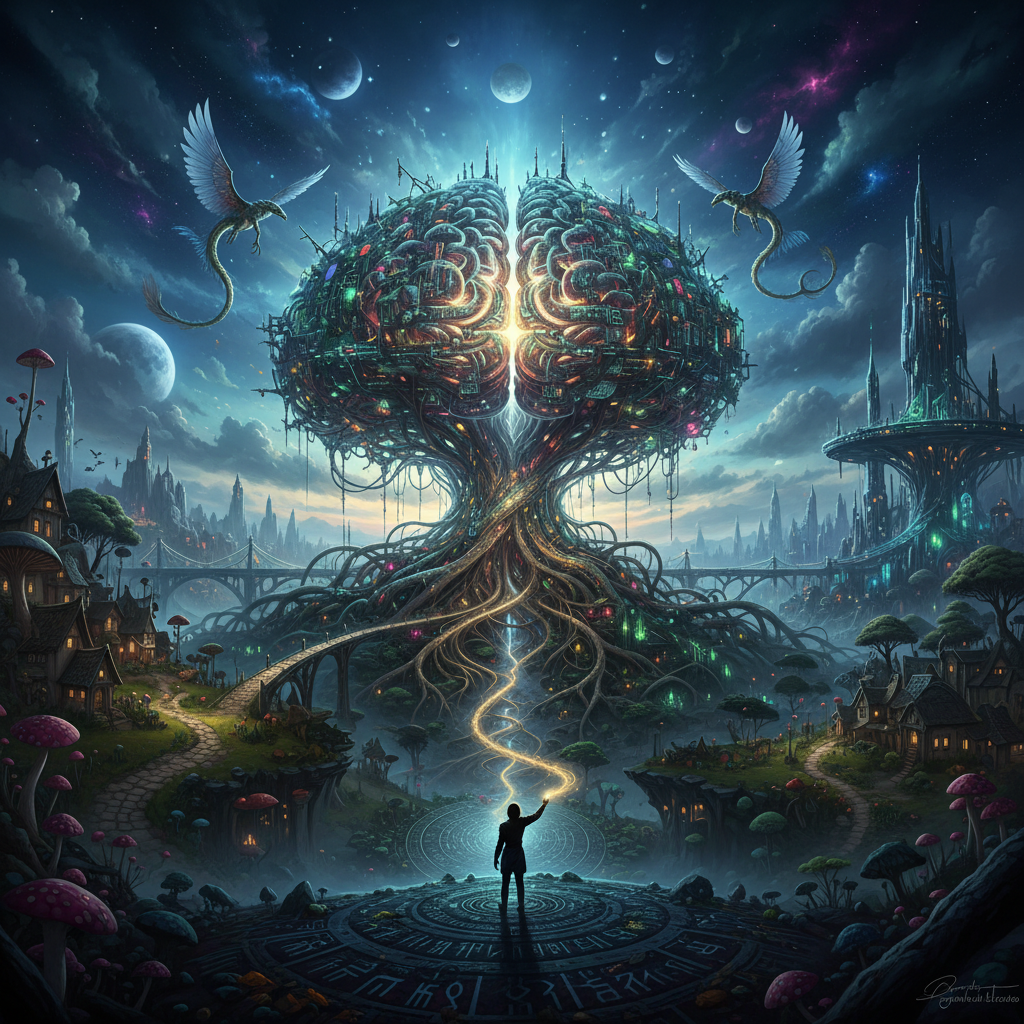
This article breaks down five epic fantasy novels renowned for their intricate, immersive world-building that readers praise for being so detailed and imaginative it fundamentally changes how they perceive fictional universes.
Some books you read. Others, you live in. In the vast realm of epic fantasy, a select few authors have achieved a level of world-building so profound, so meticulously detailed, that their creations transcend the page. These aren't just settings for a story; they are living, breathing universes with their own histories, languages, cultures, and laws of nature. Reading them is a transformative experience, one that can fundamentally alter how you perceive the very concept of a fictional world. It’s a process that feels like your brain is being rewired, creating new neural pathways to accommodate the sheer scale and depth of the author's imagination.
This is the magic behind the magic—the architectural precision that makes fantasy feel real. It’s when you feel you could navigate a city with a hand-drawn map, understand the nuances of a political feud, or recite a line in a fictional tongue. Today, we're diving into five epic fantasy novels renowned for this very quality. These are the books that readers return to again and again, discovering new layers with each visit, their worlds becoming as familiar as our own.
Any discussion of masterful world-building must begin with the legend himself. J.R.R. Tolkien didn't just write a story; he built a world from the bedrock up. Middle-earth is the gold standard, a universe so fully realized that its appendices are as compelling as its main narrative. With entire languages, millennia of history, and detailed genealogies, Tolkien crafted a world with an unparalleled sense of depth and authenticity. The sheer volume of his background notes was so vast that his son, Christopher Tolkien, was able to publish over 20 additional books based on them.
"The Lord of the Rings is the epitome of detailed world-building, compelling characters, powerful storytelling, and masterful symbolism. Readers can read the series repeatedly over years and continue to gain new insights into Middle Earth and the mind of J. R. R. Tolkien."
Tolkien's work rewires your brain by setting the ultimate benchmark for what a fantasy world can be. It teaches you that a world's power lies not just in its present, but in its deep, resonant past.
Explore The Lord of the Rings on Amazon
Where Tolkien built a world of myth and epic morality, George R.R. Martin built one of mud, blood, and brutal political realism. Westeros feels less like a fantasy realm and more like a lost chapter of human history. Martin's genius lies in his intricate web of noble houses, each with its own history, ambitions, and grievances. The magic in his world is a subtle, often forgotten force, lurking on the edges of a society consumed by very human desires for power. His characters are complex, flawed, and constantly evolving, defying the classic archetypes of good and evil.
"Readers feel as though they know Westeros, as it moves and shakes so similarly to our own world, with fantasy on its edges, in the past, forgotten or half-remembered."
Martin’s series rewires your brain by blurring the line between fantasy and historical fiction. It forces you to see the political and social machinery that underpins a world, making you a savvy observer of power dynamics both on the page and off.
Explore A Song of Ice and Fire on Amazon
Patrick Rothfuss approaches world-building with the soul of a poet and the mind of a musician. His world, Temerant, is not just seen but felt. The magic system, Sympathy, operates on logical, almost scientific principles, yet the narrative is imbued with a lyrical, folkloric quality. Rothfuss excels at building his world through the stories people tell—the myths, songs, and tavern tales that shape culture and belief. The result is a universe that feels both intellectually rigorous and deeply romantic.
As the legendary Ursula K. Le Guin wrote, "It is a rare and great pleasure to come on somebody writing the way [Patrick Rothfuss does], not only with the kind of accuracy of language that seems to me absolutely essential to fantasy-making, but with real music in the words as well."
The Name of the Wind rewires your brain by showing you that a world is defined as much by its art and culture as by its maps and histories. It makes you appreciate the power of a well-told story within a story.
Explore The Name of the Wind on Amazon
If world-building were measured in sheer scale, Robert Jordan would be a titan among titans. Spanning 14 epic novels (plus a prequel), The Wheel of Time is a monumental achievement in fantasy literature. Jordan’s world is a tapestry of countless cultures, each meticulously detailed with unique customs, clothing, and philosophies. His precise and descriptive writing style brings every town, city, and landscape to life, while the intricate plot weaves together thousands of characters and prophecies. The magic of the One Power is a complex and central force, with distinct male and female halves that shape the world’s conflict and destiny.
"Readers love Jordan's take on epic fantasy world building with sprawling character and plot points, with some reporting reading the series at least 5 times and listening to it on audible that many times."
This series rewires your brain through its sheer, staggering scope. It teaches you to track dozens of narrative threads and appreciate the slow, patient unfolding of a truly epic story, proving that the journey is just as important as the destination.
Explore The Wheel of Time on Amazon
Brandon Sanderson is a modern master of world-building, known for his 'hard' magic systems—systems with clearly defined rules and limitations that feel like their own branch of physics. In The Stormlight Archive, he presents the world of Roshar, a land battered by supernatural highstorms that have shaped its entire ecology and civilization. From the rock-like flora and fauna to the gem-based economy and the Stormlight-fueled powers of the Knights Radiant, every element of the world is interconnected. Sanderson combines this intricate environmental design with deep character development and a plot of epic proportions.
"It's an extremely immersive reading experience, with a whole world of complex characters, feuding nations, scientific-like magic systems, and unexpected plot twists. For those who love incredibly immersive worlds... this is a must read."
Sanderson’s work rewires your brain by making you see the logic in magic. It demonstrates how a single, powerful concept—like the highstorms—can be a catalyst for an entire world's unique development, from its biology to its technology and its very soul.
Explore The Stormlight Archive on Amazon
Embarking on one of these series is more than a commitment to a long story. It is an invitation to inhabit another reality. If you're ready to have your brain rewired by the power of imagination, pick any of the novels on this list. You won't just be reading a book; you'll be discovering a new world.