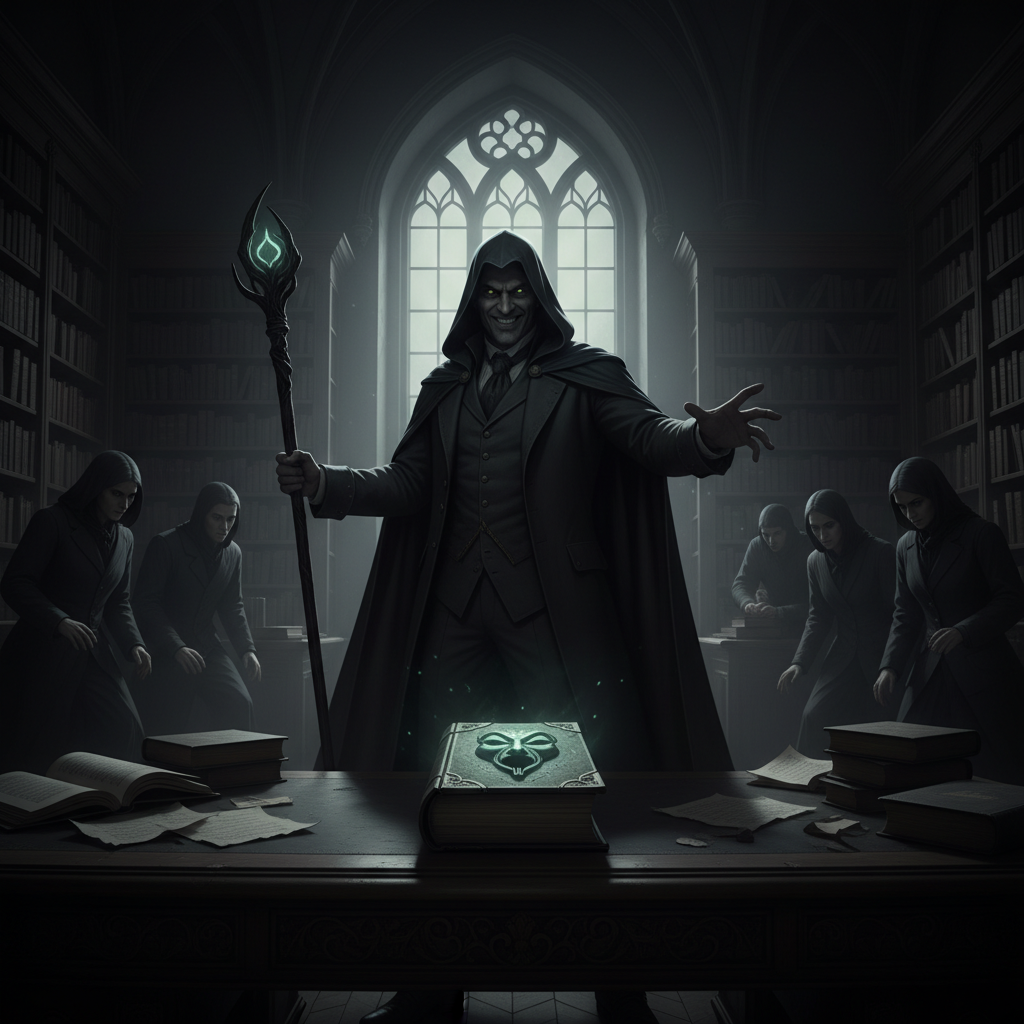
This article ranks the most compelling antagonists in fiction, exploring what makes certain villains more memorable and morally complex than the heroes they oppose.
Let's be honest: a hero is only as good as their villain. A compelling antagonist does more than just create conflict; they challenge our worldview, embody fascinating philosophies, and often possess a charisma that makes them impossible to look away from. They are the engine of the narrative, the shadow that gives the hero's light meaning. While we cheer for the protagonist, it's the morally complex villain who often lingers in our minds long after the final page is turned.
But what separates a generic baddie from a truly iconic, show-stealing antagonist? It's a potent cocktail of intelligence, agency, a twisted but coherent worldview, and a deep, often unsettling, connection to the hero they oppose. In this guide, we rank some of the most memorable and compelling literary villains who not only challenged their heroes but stole the spotlight entirely.
Before complex anti-heroes became a staple, there was Professor James Moriarty, the “Napoleon of crime.” While he appears in only one story, “The Final Problem,” his presence looms large over the entire Sherlock Holmes canon. Moriarty is not a physical brute or a cackling megalomaniac; he is Holmes’s perfect intellectual equal. He is a celebrated mathematical genius who sits at the center of a vast web of organized crime, a puppet master so brilliant that his existence is barely a whisper in the London underworld.
Why He Steals the Show: Moriarty is compelling because he is the ultimate validation of Holmes’s own genius. For the first time, Sherlock meets a mind that he cannot easily outwit. Their conflict isn’t just about crime; it's a battle of intellects, a chess match where the stakes are life and death. Moriarty forces Holmes to his absolute limit, culminating in their legendary confrontation at Reichenbach Falls. He proves that the most terrifying foe isn't one with monstrous strength, but one with a mind as sharp—or sharper—than the hero's.
“He is the Napoleon of crime, Watson. He is the organizer of half that is evil and of nearly all that is undetected in this great city... He sits motionless, like a spider in the center of its web, but that web has a thousand radiations, and he knows well every quiver of each of them.”
A masterclass in modern villainy, Amy Dunne is a chilling deconstruction of the “cool girl” trope and a terrifying product of societal expectation and personal trauma. When she disappears on her fifth wedding anniversary, all eyes turn to her seemingly clueless husband, Nick. But as the story unfolds through her diary, we realize Amy is no mere victim. She is a brilliant, meticulous, and vengeful puppet master who has crafted a narrative so perfect that it’s nearly impossible to escape.
Why She Steals the Show: Amy's villainy is captivating because it's born from a place many readers can, on some level, understand: the rage of being misunderstood, underestimated, and forced into a role you never wanted. Her actions are monstrous, but her motivations are laid bare in a way that is both horrifying and deeply unsettling. She is not just an antagonist to Nick; she is an antagonist to the very idea of marriage, media narratives, and gender roles. Amy Dunne holds a dark mirror up to society, and the reflection is anything but pretty. This character analysis reveals a villain for the modern age.
Few villains in the history of literature have been as influential or as purely, terrifyingly malevolent as Iago. Othello's trusted ensign, Iago is the architect of a tragedy built entirely on lies, insinuation, and psychological manipulation. His motives are famously murky—is it professional jealousy, racism, or a love of chaos for its own sake? This ambiguity is precisely what makes him so chilling.
Why He Steals the Show: Iago is the ultimate manipulator. He operates not with swords or poison, but with words. He whispers in Othello’s ear, planting seeds of doubt that blossom into a murderous jealousy that destroys a noble general, an innocent woman, and Iago himself. He allows the audience to be his confidante, revealing his plans in soliloquies that make us complicit in his evil. We watch, horrified, as his web tightens, and we are left to grapple with the terrifying power of language to corrupt and destroy. Iago is a timeless study in motiveless malignity and the darkness that can hide behind a friendly face.
“O, beware, my lord, of jealousy; It is the green-ey'd monster, which doth mock The meat it feeds on.”
Dr. Hannibal Lecter is a paradox: a brilliant psychiatrist, a connoisseur of fine arts and classical music, and a cannibalistic serial killer. Trapped behind glass, he is more psychologically dominant than any character in the room. His relationship with FBI trainee Clarice Starling is one of the most compelling hero-villain dynamics ever written. He helps her hunt another killer, but his price is access to her mind, her fears, and her past.
Why He Steals the Show: Lecter’s charisma is his greatest weapon. He is polite, erudite, and utterly terrifying. Readers are drawn to his genius and repulsed by his brutality in equal measure. He represents a horrifying breakdown of order—a man of immense intellect and culture who has utterly rejected societal morality. He doesn't just kill; he dissects, both literally and figuratively. His analysis of Clarice, and by extension the reader, is so insightful that we cannot help but be captivated. Hannibal Lecter is a truly memorable antagonist because he forces us to confront the idea that genius and monstrosity can exist in the same brilliant mind.
At the top of our list is a character who is less a man and more a terrifying, elemental force. Judge Holden is a massive, hairless, and unnervingly intelligent member of the Glanton Gang, a group of scalp hunters on the US-Mexico border. He is a polymath—fluent in multiple languages, an expert in geology, philosophy, and music—and a being of pure, unadulterated violence. He is never seen sleeping and seems to be a master of all he surveys, declaring that war is the ultimate god.
Why He Steals the Show: Judge Holden is the most terrifying villain in literature because he is an argument. He is the physical embodiment of the philosophy that violence and domination are the natural state of humanity. He isn't driven by greed, revenge, or any recognizable human motive; he is driven by a theological devotion to war itself. The Judge's evil is absolute and philosophical. He challenges not just the characters in the book, but the reader's fundamental understanding of morality, history, and human nature. He is a truly morally complex villain who suggests that evil isn't an aberration, but a fundamental, eternal principle of the universe. He never leaves you.
“Whatever in creation exists without my knowledge exists without my consent.”
Looking at these iconic figures, a clear pattern emerges. The best literary villains are more than just obstacles. They are defined by a few key traits:
Ultimately, a show-stealing villain elevates their story from a simple tale of good versus evil into a complex exploration of human nature itself. They make us uncomfortable, they make us question our own moral compass, and that is why they are truly unforgettable.