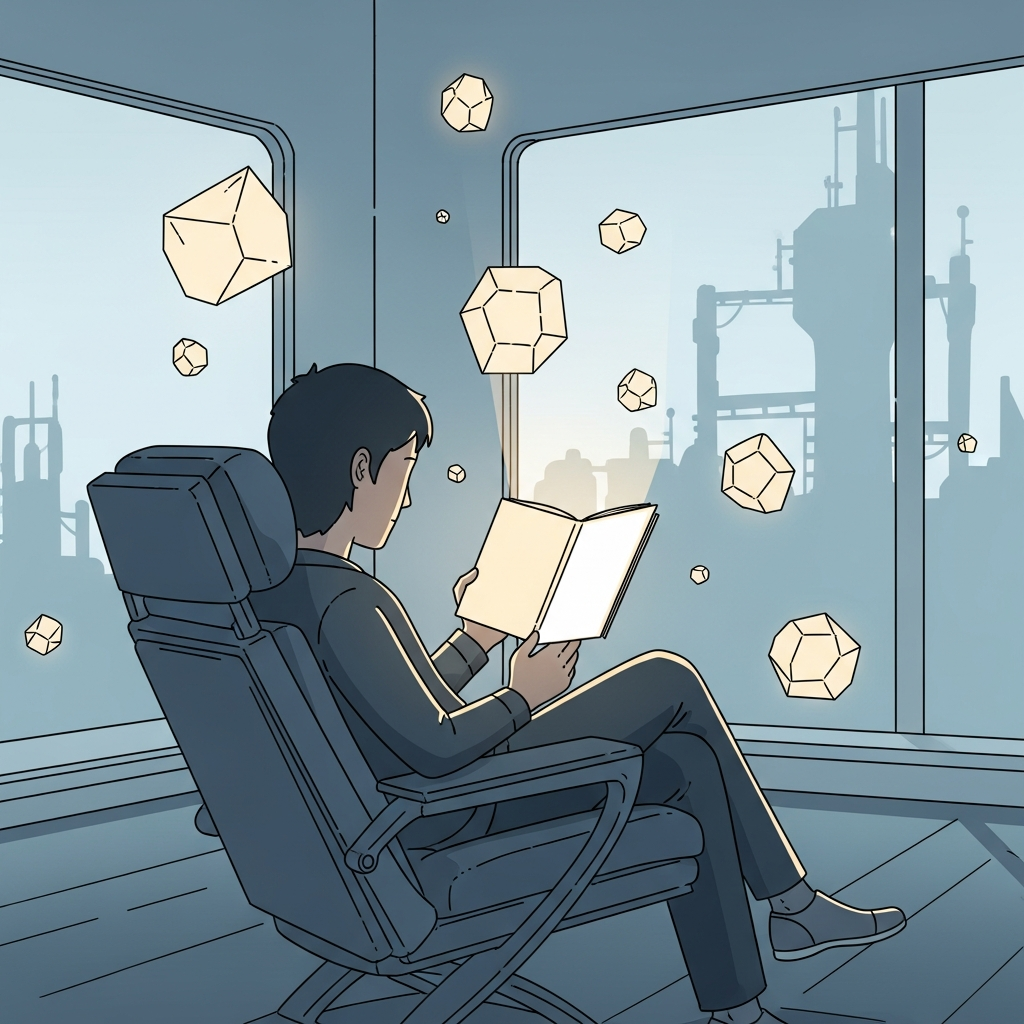
Discover five profound science fiction novels that explore consciousness, identity, and the nature of existence. These books go beyond spaceships and lasers to challenge how you perceive the world.
Science fiction is often dismissed by critics as mere escapism—a genre defined by laser battles, faster-than-light travel, and green-skinned aliens. While those elements can certainly be fun, the true power of the genre lies in its ability to act as a philosophical laboratory. By stripping away the constraints of our current reality, authors can test hypotheses about human nature, consciousness, and society in ways that realistic fiction simply cannot.
The best philosophical sci-fi does not just tell a story; it presents a thought experiment. It asks us to consider who we would be if our memories could be edited, if our gender was fluid, or if our consciousness could exist within a machine. The following five novels are masterpieces of the genre, selected not just for their narrative grip, but for their ability to make you question the fundamental nature of existence.
In a genre often dominated by individual heroes, Ann Leckie’s Ancillary Justice asks a fascinating question: What happens when a collective consciousness is shattered into a single, fragile fragment?
The protagonist, Breq, was once the Justice of Toren, a colossal starship AI that controlled thousands of "ancillaries"—human bodies conscripted as soldiers for the Radch empire. Connecting thousands of minds into a single purpose, she was vast and powerful. Now, due to a betrayal, she is reduced to a single human body. The novel explores the trauma of this reduction and the uneasy balance between individuality and membership in a group identity.
Leckie also challenges our perception of gender. The Radch culture does not distinguish by gender, and Breq uses female pronouns for everyone, forcing the reader to abandon their biases regarding character traits and roles. It is a slow-burning revenge story that doubles as a meditation on the expanded meaning of human nature.
Buy Ancillary Justice on Amazon
While this is a collection of short stories and novellas rather than a single novel, Ted Chiang’s work is essential reading for anyone interested in philosophical fiction. Chiang is not a prolific writer, but every story he publishes lands with the weight of a philosophical treatise.
The standout title story, "Story of Your Life" (which was adapted into the film Arrival), grapples with the concept of linguistic relativity—the Sapir-Whorf hypothesis. It asks if learning a language that perceives time simultaneously rather than sequentially could rewire the human brain to see the future. This leads to a heartbreaking and profound inquiry into free will versus determinism. If you knew the tragic ending of your life story, would you still choose to live it?
Chiang’s stories make abstract debates visceral. He explores the intersection of theology and science, the nature of intelligence, and the emotional consequences of knowing too much. It is widely considered the epitome of what science fiction strives to achieve.
Buy Stories of Your Life and Others on Amazon
No list of philosophical science fiction is complete without Ursula K. Le Guin. The Left Hand of Darkness is a visionary work that challenged the entire landscape of the genre upon its release. The story follows Genly Ai, a human emissary sent to the planet Gethen to invite its inhabitants to join an intergalactic collective.
The philosophical core of the novel lies in the biology of the Gethenians: they are ambisexual, having no fixed gender identity, only assuming sexual characteristics during a mating cycle. Le Guin uses this premise to strip away gendered societal norms, asking us to imagine a society where war, politics, and love are not defined by the binary of male and female.
Beyond the gender critique, it is a story about the difficulty of true communication between cultures and the deep, often painful, human need for connection. It remains a deeply human story about how gender divides work to isolate us as groups and individuals, and how we might bridge that gap.
Buy The Left Hand of Darkness on Amazon
For those who prefer their philosophy grounded in hard science and mathematics, Greg Egan’s Permutation City is the ultimate mind-bender. This novel dives headfirst into the transhumanist dream—and nightmare—of uploading consciousness to a simulated reality.
Set in a near-future where wealthy individuals can create digital copies of themselves to achieve immortality, the book asks difficult questions about the continuity of self. If you can pause, edit, and copy your mind, are you still you? Egan explores the "Dust Theory," a concept suggesting that the physical substrate of the universe matters less than the patterns of information that constitute it.
Be warned: this is a dense read. Readers often describe it as a challenging ride that prioritizes heavy exploration of ideas over fast-paced action. However, for those willing to engage with its rigor, it offers one of the most thorough examinations of subjective reality and existence ever written.
Buy Permutation City on Amazon
N.K. Jemisin made history by winning the Hugo Award for every book in her Broken Earth trilogy, starting with this masterpiece. While it functions as a gripping survival story set on a geologically unstable continent, The Fifth Season is also a searing philosophical examination of systemic oppression and the justification of suffering.
The world of the Stillness relies on "orogenes"—people with the power to quell earthquakes and control energy. Despite their utility, they are feared, enslaved, and dehumanized by the very society they protect. Jemisin uses this setup to explore the sociology of power and the trauma of living in a world designed to kill you.
One of the most striking philosophical devices in the book is the use of the second-person point of view ("You") for one of the narrative threads. This forces the reader into a direct, uncomfortable intimacy with the protagonist’s suffering and choices, dissolving the barrier between the observer and the observed.
Buy The Fifth Season on Amazon
These five novels demonstrate that science fiction is far more than entertainment. Whether exploring the fluidity of gender, the definition of the soul in a digital age, or the crushing weight of systemic oppression, these authors use the fantastic to illuminate the real. By engaging with these works, you aren't just reading a story; you are participating in a dialogue about what it means to be human.