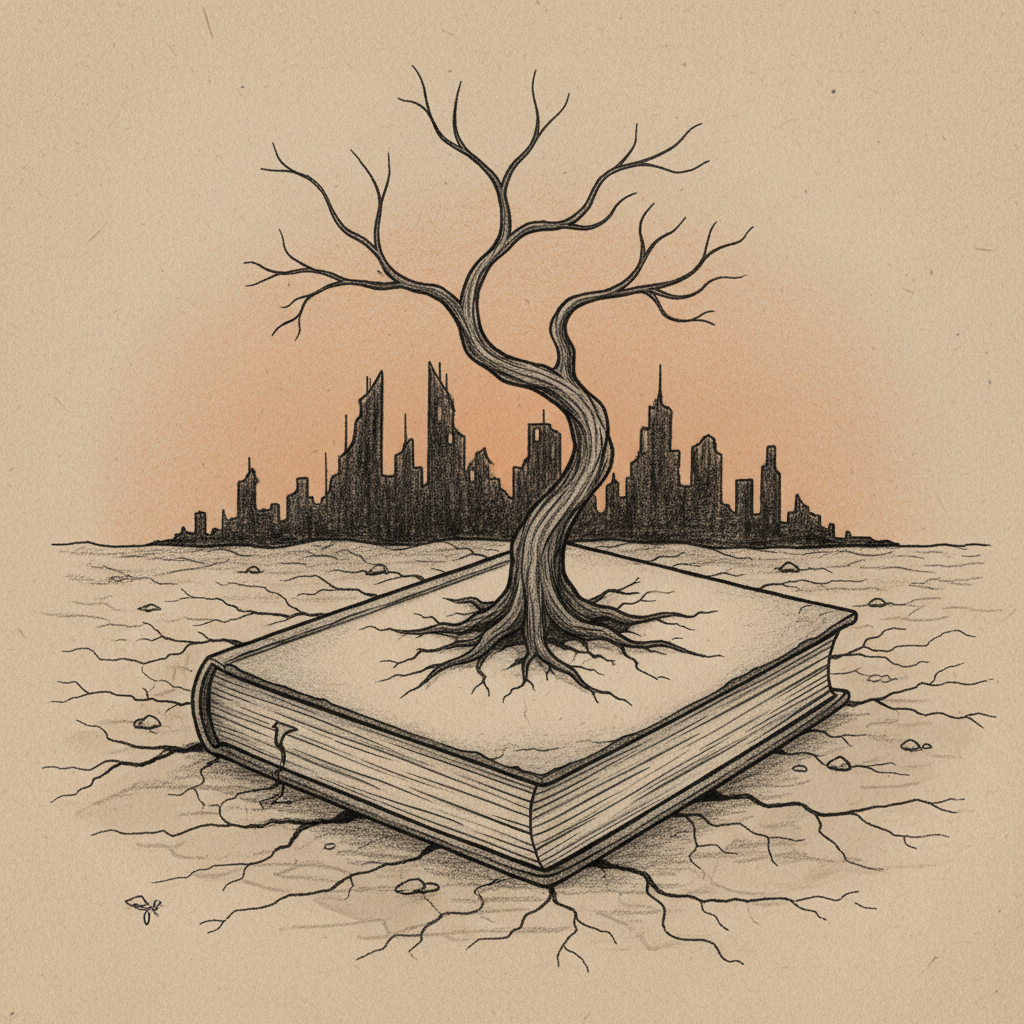
This article examines thought-provoking literary novels that tackle environmental collapse and climate anxiety through character-driven storytelling, offering readers a different perspective on how literary fiction addresses one of today's most pressing concerns.
When we think of the apocalypse, our minds often conjure images of Hollywood blockbusters: asteroids, explosions, and humanity’s dramatic, last-ditch fight for survival. But a growing genre of literary fiction is exploring a different kind of ending—one that is quieter, slower, and unnervingly familiar. This is the world of climate fiction, or “cli-fi,” where the apocalypse isn’t a singular event, but a creeping, insidious collapse driven by environmental change. More importantly, these stories aren’t about spectacle; they are deeply human explorations of how we live, love, and find meaning on a planet in crisis.
What was once the domain of speculative science fiction has moved firmly into the literary mainstream. Novelists are turning their attention to the defining challenge of our era, not with charts and data, but with the powerful tools of character, empathy, and narrative. They invite us to step into the shoes of individuals grappling with a world that is subtly—and then suddenly—unraveling. These novels don't just ask “what if?”; they ask “what now?”. By focusing on the personal, they make the planetary feel urgent and real. Here, we delve into three exceptional novels that exemplify this character-driven approach to the quiet apocalypse.
It is impossible to discuss modern climate fiction without paying homage to Octavia E. Butler. Published in 1993, Parable of the Sower is a foundational text that feels less like a prediction and more like a prophecy unfolding in real-time. The novel is set in a 2020s California ravaged by climate change, wealth inequality, and social breakdown. Water is scarce, public services have collapsed, and gated communities offer the only illusion of safety.
But the story’s power comes not from its world-building, but from its protagonist, Lauren Olamina. A young Black woman living with “hyperempathy”—a condition that forces her to feel the pain and pleasure of others—Lauren is a powerful metaphor for a generation grappling with an overwhelming sense of global suffering. Her journey north, away from the ashes of her home, is a harrowing tale of survival. Yet, it is also a story of profound creation. Amid the chaos, Lauren develops a new faith system, Earthseed, whose central tenet is that “God is Change.”
Butler masterfully illustrates that the apocalypse is not just about external destruction but internal transformation. Lauren's story is a testament to human resilience and the radical act of imagining a future when the present is crumbling. It’s a terrifying read, precisely because its vision of a future shaped by “willful ignorance, racism and greed” feels so close. Yet, through Lauren’s courage, it offers a blueprint for adaptation and a sliver of determined hope.
Find it on Amazon: Parable of the Sower by Octavia E. Butler
While some cli-fi looks to the future, Imbolo Mbue’s masterful 2021 novel, How Beautiful We Were, roots its environmental crisis in the long, painful history of colonialism and corporate exploitation. Set in the fictional African village of Kosawa, the story chronicles a community’s decades-long fight against an American oil company whose pollution has poisoned their land and children. The novel explicitly avoids the speculative, instead grounding its narrative in an all-too-real struggle for environmental justice.
The story is told from multiple perspectives, including a generation of children who grow up in the shadow of environmental ruin. Most powerful is the collective voice of “The Children,” a narrative choice that transforms a personal story into a sweeping, communal epic. We watch as one of their own, Thula, grows from a curious girl into a fierce revolutionary, willing to sacrifice everything for her people. Mbue’s novel is a profound exploration of what happens when a community’s ancestral land and spiritual well-being are sacrificed for profit.
How Beautiful We Were is a parable for our global crisis, demonstrating how the consequences of environmental damage are disproportionately borne by marginalized communities. It doesn't offer easy answers; instead, it asks difficult questions about the cost of resistance and the meaning of progress. It is a heartbreaking and infuriating novel that, as one reviewer noted, makes you “angry enough to fight back.” It’s a vital reminder that the climate crisis is inextricably linked to issues of justice, power, and history.
Find it on Amazon: How Beautiful We Were by Imbolo Mbue
How does a global phenomenon become a personal reality? In her 2012 novel Flight Behavior, Barbara Kingsolver tackles this question by bringing an international climate event to the doorstep of one woman in rural Appalachia. Dellarobia Turnbow, a young, restless farm wife feeling trapped by poverty and circumstance, is on her way to begin an affair when she stumbles upon a breathtaking, silent miracle: a valley behind her home is filled with millions of monarch butterflies, glowing like a lake of fire. They are beautiful, but they are not supposed to be there. They have been thrown catastrophically off their migratory course by changing weather patterns.
The novel’s genius lies in its protagonist. Dellarobia is not an activist or a scientist. She is skeptical, sharp-witted, and deeply embedded in a community that is suspicious of scientific authority and more concerned with immediate survival than abstract global threats. The arrival of the butterflies, and the scientists who follow, forces her to confront a world far beyond her own experience. Her personal awakening becomes a microcosm for the broader societal struggle to accept the reality of climate change.
Kingsolver elegantly weaves together the threads of science, faith, poverty, and personal desire. Flight Behavior demonstrates how literary fiction can bridge the gap between abstract data and lived experience, showing that the most profound environmental stories are often about the transformations that happen within a single human heart.
Find it on Amazon: Flight Behavior by Barbara Kingsolver
Though vastly different in setting and style, these novels share a common purpose: they make the unthinkable feel intimate. They move the climate crisis from the realm of headlines and scientific reports into the sphere of human emotion—grief, love, fear, and hope. By focusing on the quiet, personal apocalypses of their characters, Butler, Mbue, and Kingsolver give us a language to process our own climate anxiety.
These stories are not simply dystopian warnings. They are complex meditations on resilience. They suggest that our survival depends not on technological fixes alone, but on our capacity for empathy, our ability to form communities, and our courage to imagine and build new ways of living. While reading about environmental collapse can feel heavy, these narratives invite us to do more than despair. They invite us to connect, to understand, and ultimately, to act, reminding us that even in the face of overwhelming change, the human story continues.