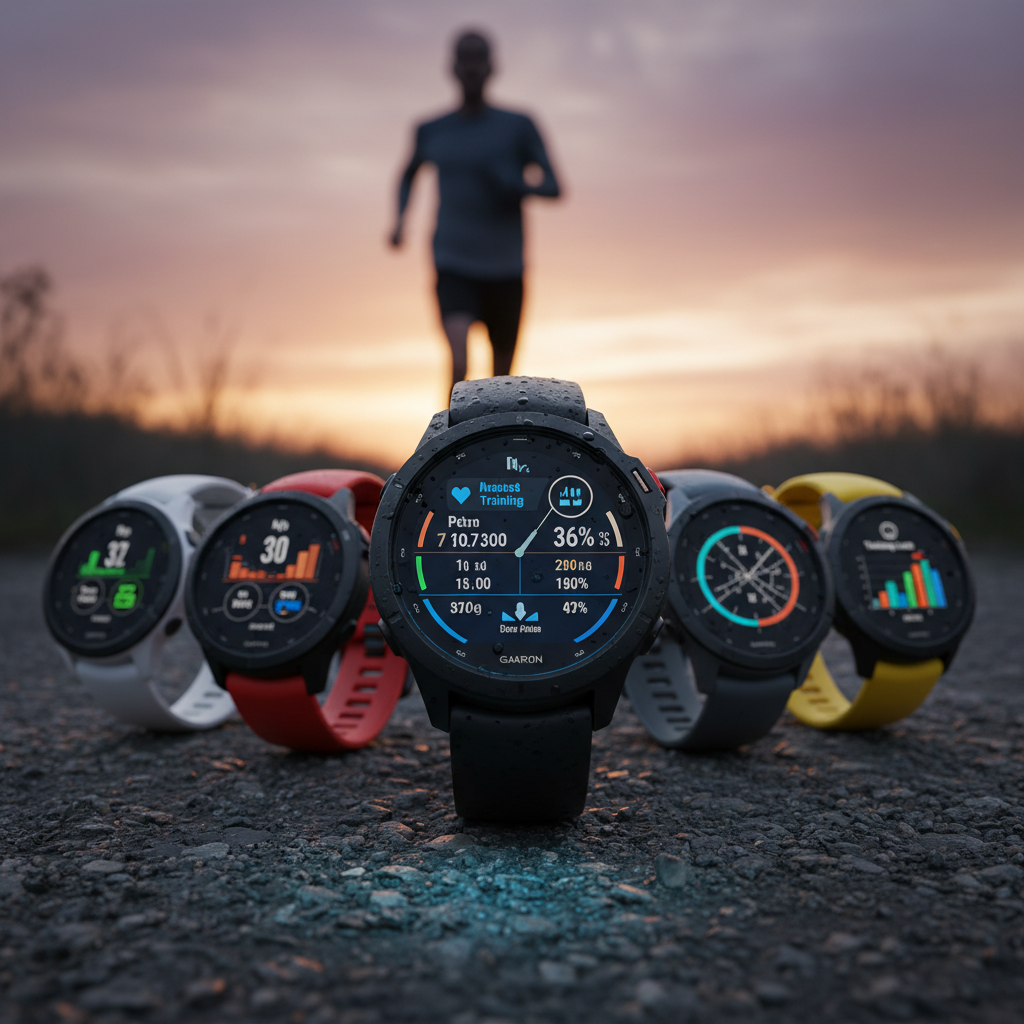
This deep dive compares the best GPS-enabled running watches that go beyond basic fitness tracking to offer serious runners detailed training analytics, coaching features, and performance insights.
For serious runners looking to optimize their training, a GPS running watch with advanced metrics is no longer a luxury—it's an essential tool. Today's premium running watches offer far more than basic distance and pace tracking; they provide comprehensive training insights, recovery analytics, and performance coaching that can transform how you approach your workouts. After extensive testing and analysis of user feedback across major retailers, we've identified the five best GPS running watches that deliver meaningful training data to help you reach your goals.
The Garmin Forerunner 965 stands as Garmin's flagship running watch, combining a stunning 1.4-inch AMOLED display with comprehensive training features that serious athletes demand. With a titanium bezel, lightweight 53g design, and up to 31 hours of GPS battery life, this watch delivers both form and function.
The Forerunner 965 excels in providing actionable training insights. The Training Readiness feature analyzes your sleep quality, recovery status, training load, and HRV to tell you when you're primed for a hard session or need to take it easy. The watch also includes multi-band GPS for exceptional accuracy even in challenging environments like dense urban areas or under tree cover.
- VO2 Max estimation and race time predictions
- Training Load Ratio (acute vs. chronic load)
- Built-in running dynamics (vertical oscillation, ground contact time, stride length)
- PacePro for gradient-adjusted pacing strategies
- ClimbPro to preview upcoming elevation gains
- Full-color topographic maps for navigation
Amazon reviewers consistently praise the Forerunner 965's accuracy and comprehensive feature set, with most rating it 4.5 stars or higher. Users particularly appreciate the bright AMOLED screen's readability in direct sunlight and during runs. The morning report feature, which provides an overview of HRV status, sleep quality, and training outlook, receives frequent mentions as a game-changer for planning daily workouts.
Some ultra-runners note that while the 31-hour GPS battery life is excellent for most races, those tackling 100-mile events may need to consider battery-saving modes. A few users mention the $599 price point is steep, but most conclude the investment is worthwhile given the depth of features.
The Coros Pace 3 has earned a reputation as the best value in GPS running watches, delivering advanced metrics and exceptional battery life at a fraction of the cost of premium competitors. Weighing just 30 grams with a nylon strap, it's one of the lightest performance watches available.
Don't let the affordable price fool you—the Pace 3 packs serious technology. It features dual-frequency GPS for improved accuracy, supporting five satellite systems (GPS, GLONASS, Galileo, Beidou, QZSS). The watch provides detailed running metrics including wrist-based running power, advanced running dynamics, and comprehensive training load analysis through Coros's EvoLab platform.
- Up to 38 hours of GPS battery life
- Dual-frequency GPS for enhanced accuracy
- Wrist-based running power (no external sensors required)
- Training load and fitness level tracking
- Breadcrumb navigation with route guidance
- VO2 Max estimates and race predictions
- 20+ sport modes including triathlon support
Target and Walmart shoppers rate the Pace 3 highly for its reliability and battery life, with many noting it easily lasts two weeks between charges with regular training. Users appreciate the simple, focused interface that doesn't overwhelm with smartwatch notifications. The GPS accuracy receives consistent praise, with runners reporting it matches or exceeds more expensive competitors.
The main complaints center on limited smart features—there's no Spotify integration (only MP3 file storage), no contactless payments, and music management requires connecting to a computer. Some users also note the processor feels slightly slower than premium watches when navigating menus, though this hasn't affected workout tracking.
The Polar Vantage M3 represents Polar's return to flagship form, featuring a gorgeous 1.39-inch AMOLED display and the company's legendary expertise in heart rate monitoring and training load analysis. At around $599, it competes directly with the Garmin Forerunner 965 but differentiates itself with superior recovery insights.
Where the Vantage M3 truly shines is in recovery and training load management. The watch uses Polar's well-established Training Load Pro system, which provides clear guidance on whether you're training productively, maintaining fitness, or risking overtraining. The new Elixir biosensor enables ECG measurements, blood oxygen tracking, and nightly skin temperature monitoring.
- Dual-frequency GPS for accuracy
- Wrist-based ECG (30-second test via button contact)
- Nightly Recharge recovery assessment
- Recovery Pro with orthostatic testing
- Leg Recovery Test (unique jump test feature)
- Training Load Pro with clear visual indicators
- Full offline maps with turn-by-turn navigation
- 150+ sport profiles
- Sleep tracking with skin temperature trends
Amazon purchasers consistently highlight the Vantage M3's exceptional sleep tracking accuracy, noting it correctly identifies wake periods during the night better than competitors. The Nightly Recharge feature receives praise for providing genuinely useful guidance on daily training intensity. Athletes appreciate that all features are included with no subscription fees—a significant advantage over some competitors.
Common criticisms include inconsistent battery life reports (some users get 9-10 days, others only 4-5), occasional heart rate monitoring inaccuracies requiring a chest strap for precision, and navigation that works better in urban environments than remote trails. The water resistance was reduced from 100m on the V2 to 50m on the M3, disappointing some swimmers.
The Garmin Fenix 8 AMOLED represents the pinnacle of multisport watches, combining rugged durability with cutting-edge training technology. Available in three case sizes (43mm, 47mm, 51mm), it offers the most comprehensive feature set of any watch on this list.
The Fenix 8 includes everything found on the Forerunner 965 plus additional features for adventure athletes. New for this generation is Dynamic Routing, which generates turn-by-turn directions mid-workout if you deviate from your planned route. The watch is built like a tank with 40-meter dive rating, thermal and shock resistance, and a built-in LED flashlight.
- Multi-band GPS with exceptional urban accuracy
- Dynamic Routing for adaptive navigation
- Full topographic maps preloaded
- Training Readiness and Load monitoring
- Advanced running dynamics and metrics
- Hill Score and Endurance Score tracking
- Leakproof metal buttons
- Speaker and microphone (phone calls from wrist)
- Up to 48 days battery in smartwatch mode (51mm solar model)
Walmart and Target customers rate the Fenix 8 extremely highly, with adventure athletes and ultra-runners particularly enthusiastic. Users love the always-on AMOLED display's brightness and the watch's ability to handle everything from diving to mountain climbing. The battery life receives consistent praise, especially on the larger models.
The main drawbacks are size and price. The 51mm model is substantial and may overwhelm smaller wrists, while the price ranges from $999-$1,199 depending on configuration. Some runners note that for pure running focus, the Forerunner 965 offers similar metrics in a lighter, more affordable package.
The Apple Watch Ultra 2 brings Apple's ecosystem advantages to serious running, combining advanced training metrics with unmatched smart features. The 49mm titanium case houses a brilliant 2000-nit display and dual-frequency GPS.
With watchOS 9 and later, Apple has significantly improved its running metrics. The Ultra 2 now tracks running power, stride length, ground contact time, vertical oscillation, and provides training load analysis. The Workout app offers interval training, pace alerts, and heart rate zones. For iPhone users, the integration with Apple Health, Messages, and other apps is seamless.
- Dual-frequency GPS for improved accuracy
- Running power and advanced form metrics
- Training load and recovery tracking
- VO2 Max estimation
- Triathlon mode with automatic transitions
- Customizable workout views
- Action button for quick workout starts
- Emergency SOS and fall detection
- Up to 36 hours battery life
Amazon reviewers who are iPhone users rate the Ultra 2 highly for its integration and usability. The bright display is readable in any conditions, and the Action button provides convenient workout control. Athletes appreciate the cellular connectivity for safety during solo runs. The third-party app ecosystem offers thousands of training options beyond Apple's native apps.
The primary limitation is battery life—36 hours maximum means daily or every-other-day charging, which is problematic for ultra-distance events. The watch only works with iPhones, limiting its audience. Some serious runners feel the training analytics, while improved, still lag behind Garmin and Polar's depth. At $799, it's expensive, though the smart features justify the cost for Apple ecosystem users.
The intensity and structure of your training should guide your choice. Casual runners logging 10-20 miles per week may find the Coros Pace 3 provides all necessary metrics at an unbeatable price. Marathon and ultra-marathon trainers benefit from the comprehensive analytics of the Forerunner 965 or Polar Vantage M3, which help prevent overtraining through recovery tracking. Multi-sport athletes and adventure runners might prefer the Fenix 8's rugged build and extensive battery life.
Consider your longest typical activity. If you're training for marathons (4-6 hours), most watches handle this easily. Ultra-runners tackling 50K to 100-mile events need watches offering 30+ hours in GPS mode—the Coros Pace 3 (38 hours), Forerunner 965 (31 hours), and especially the Fenix 8 (up to 95 hours) excel here. The Polar Vantage V3's 61-hour rating is also excellent for multi-day adventures.
All five watches on this list feature dual-frequency or multi-band GPS, which dramatically improves accuracy in challenging environments like cities with tall buildings or trails under heavy tree cover. User reviews consistently confirm these watches track within 0.1-0.2 miles over marathon distances when compared to measured courses. For heart rate accuracy during intense intervals, consider pairing any watch with a chest strap—even the best optical sensors can struggle with rapid changes.
Decide whether you want a training tool or a daily smartwatch. The Coros Pace 3 and Polar Vantage V3 focus on athletics with limited smart features—no music streaming, contactless payments, or extensive app ecosystems. The Garmin watches offer middle ground with music storage, Garmin Pay, and notification support. The Apple Watch Ultra 2 provides complete smartphone functionality but requires daily charging.
Training Load measures the physiological impact of your workouts, typically expressed as a score based on duration, intensity, and heart rate data. Acute Load (last 7 days) compared to Chronic Load (last 28 days) helps identify whether you're building fitness sustainably or risking injury through overtraining. The Garmin watches show this as Training Load Ratio, while Polar provides Training Load Pro with clear visual guidance.
-
-
-
-
-
VO2 Max estimates your body's maximum oxygen consumption capacity, a key indicator of aerobic fitness. All five watches calculate this using GPS data, heart rate, and running pace. While not laboratory-accurate, the trend over time reliably shows fitness improvements or declines. Based on your VO2 Max, the watches predict race finish times for distances from 5K to marathon, helping you set realistic goals.
For most serious runners, the Garmin Forerunner 965 represents the sweet spot of features, accuracy, and usability. Its comprehensive training metrics, excellent battery life, and proven reliability justify the premium price for dedicated athletes. The bright AMOLED screen and lightweight design make it comfortable for all-day wear.
Budget-conscious runners should strongly consider the Coros Pace 3, which delivers 80% of the Forerunner's training features at 40% of the price. The exceptional 38-hour GPS battery life and accurate dual-frequency GPS make it an incredible value. You sacrifice some smart features and the premium display, but the core running functionality is outstanding.
Athletes obsessed with recovery and training load optimization will appreciate the Polar Vantage V3's sophisticated analytics and superior sleep tracking. The no-subscription-required approach to all features is refreshing in an increasingly subscription-heavy market.
For adventure athletes and ultra-runners, the Garmin Fenix 8 AMOLED is the ultimate tool, offering unmatched durability and battery life along with every training metric imaginable. The investment is significant, but so is the capability.
Finally, iPhone users who want a true smartwatch that also handles running seriously should choose the Apple Watch Ultra 2. While the training analytics don't quite match Garmin or Polar's depth, the seamless integration with your digital life and safety features like cellular connectivity make it compelling for the right user.
Whichever watch you choose, remember that the best training tool is the one you'll actually use consistently. These five GPS running watches all deliver accurate tracking and meaningful insights—your job is to put in the miles and let the data guide your improvement.